Wednesday, February 29, 2012

Sam Spratt has PAINTED ALL THE MEMES!

Sam Spratt's website describes his work as having "sprattitude". This fine arts graduate combines classical training with current ideas, many of which stem from online media and internet memes. 


PAINT ALL THE MEMES!
Spratt's collection of paintings entitled Illustrated Internet is based on what he calls the visual vernacular of the internet. These paintings are based on popular internet media characters found in rage comics. Most of these characters are used online in their original form; simple black and white sketches of an expressive cartoon face. Spratt has fleshed out these characters by giving them a 3-dimensional existence.

Above: "Paint all the memes!" based on "X all the Y". This character has been used as a template for expressing a fanatical point of view. Notable variations are "Clean all the things!" and "Eat all the brains!" [source]

Above: The rage comics fffuuu face. The painting of the meme character is complete with flying spittle and red eyes. [source]

Above: An expressive painting of the meme Forever Alone. [source]

Paintings of Memes
Although there are thousands of fan art works of internet memes, Spratt's paintings are original in that he has removed the characters from their ordinarily 2-dimensional state and given them a fleshy substance. Although each of the faces still stands alone, bereft of a body, the characters are complete.
Sam Spratt's art style uses a combination of messy brushwork and careful lighting to create the overall effect of a character suspended in endless space.


Above: Trollface in 3D. The troll face rage comics character is used to express delight or humor at someone else's misfortune, and is often used in forums, comics and .gif animations. [source] See more trollface fan art works. 


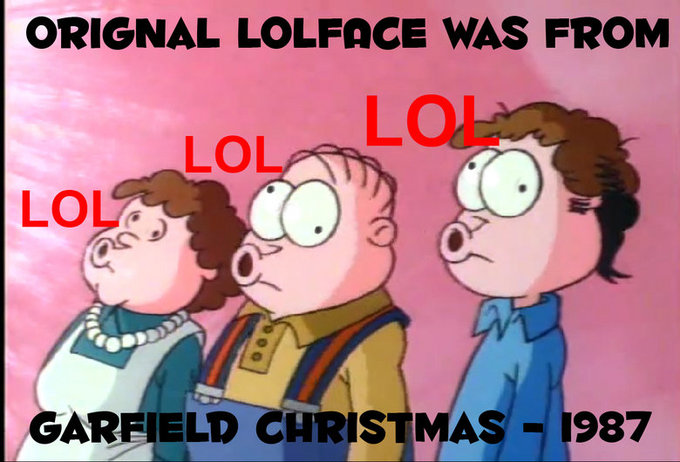
Above: LOL face. Rumor has it that the original lolface appeared in Garfield Christmas 1987. [source]

Above: Me Gusta. The rage comics character is used to express a sickening enjoyment of disturbing media. [source]


Trollface gets Immortalized in Art

The Trollface (or Troll Face) character has its origins in a comic created by Deviant Art user Whynne in 2008. The original comic was intended to express how pointless trolling on 4chan was. Since its creation, the Trollface character has become an online meme, popping up in thousands of rage comics and fan art works.

Mona Lisa Troll Face
Leonardo da Vinci's famous painting, the Mona Lisa, is a popular subject for character hybrids and parody art. In the picture below, the Mona Lisa gets trolled by the infamous meme, Trollface. Ordinarily Troll face is depicted in black and white, but the artist has used color in this Photoshop face swap to blend the two characters into one subject, the Trolla Lisa.

Above: Leonardo da Vinci's famous painting, Mona Lisa, gets trollfaced. [source]

The Fine Art of Trolling
Artist Sam Spratt has PAINTED ALL THE MEMES! This fine arts graduate has created a series of paintings of internet memes and posted them online. One of the most appreciated paintings in the collections is the painting of Trollface. The character has been fleshed out, complete with wrinkles, shiny eyeballs and the hint of a tongue. This is most likely what Troll face would look like if he were real.

Above: Sam Spratt's artistic interpretation of Trollface shows the rage comics character as he would appear if he were made of flesh and blood. [source]

Trollface gives a Load of Lip
A photographed body art version of the famous meme, Troll face. The appeal of this photograph is that it doesn't use photo manipulation. Instead, this girl has used body paint to transform her own grin into that of Trollface. 

Above: Troll face gets lippy in this meme body art design. [source]

Trollface in his Troll Cave
In this meme fan art work, Troll face is depicted in his cave, trolling the internet with his troll laptop. The Trollface character is used on forums, in cartoons and in .gif animations to show that someone has been trolled, and is often added into videos at the moment where someone messes up.

Above: Deviantart's Faeorain shows Troll face as a humanoid troll character. [source]


Get Troll Faced on Halloween
Artist Psycho-Stress creates masks of popular memes, such as trollface, Me Gusta and Forever Alone for Halloween. The white plastic and black paint mimic the design of the original black and white Trollface sketch.

Above: Halloween gets troll faced with this internet meme fan art mask. [source]

Troll Face looks like Robin Williams?
This artist's painting of the rage comic character depicts troll face as looking a little like actor/comedian Robin Williams. 

Above: Problem? [source]

Photo Manipulated into Troll Face
For this artist, evolution was not happening fast enough, so he used Photoshop to turn this guy's face into a real life Trollface. For a bit of fun he's added a top hat, monocle and a pipe to create a steampunk affect.

Above: A Photoshop image manipulation depicting Trollface as a real human being. [source]


Mayhem and Muse: Artistic Inspiration and Funny Videos

Catherine South is proud to present Mayhem and Muse, Art-Sci's sister site. Mayhem and Muse offers popular internet media as well as the work of lesser-known artists, performers and creators.


Be Inspired with Mayhem and Muse
Mayhem and Muse offers a wide variety of inspirational posts; videos based on human talent, courage and achievement, and art, illustration and paintings that showcase the work of both famous and emerging artists. On the site, artists and designers can find inspiration for creative projects, and for those who simply need a pick-me-up, Mayhem and Muse offers a humor section that is bound to cheer you up.


Above: The unusual art style of Philip Bosmans, a graffiti artist who has turned to the more traditional style of fine art painting. Visit Mayhem and Muse or more interesting painting styles.

Above: The Exquisite Tattoo Designs of Alex De Pase. De Pase's body art portfolio is made up of amazing tattoo art works that combine fantasy and photorealism.


Watch Videos on Mayhem and Muse
Mayhem and Muse allows internet users to watch videos on the front page. Each video is chosen for the purpose of inspiring, entertaining or simply conveying a different perspective on life. Watch Gene Kelly Tap Dancing on Roller Skates, Extreme Ironing, for Domestic Daredevils and The Evolution of Dance.


Connect with Mayhem and Muse
Mayhem and Muse is updated daily. To receive links to new posts on Mayhem and Muse, you can follow us online, on facebook, twitter and via rss feed.


Be inspired

Monday, February 27, 2012

The Best Photorealistic Drawings

Photorealism is an art form in which artists create drawings or paintings that look like photos. However photorealistic a drawing may be; the artist's personality will leak into the art work, giving the finished result a unique essence of its own.

Fantastic Photorealistic Drawings
Truly fantastic photo realistic drawings use a combination of perspective, proportion and lighting to create a realistic effect. If any of these design elements are not adhered to, the finished work will not withstand close scrutiny. Shading and highlights are especially important, as they define the 3D realism of the drawing. If the shading is not smooth, the drawing looks less like a photo and more like an art work.

Above: Jono Dry is a young artist from South Africa who draws photo realistic drawings based on his own photos. With no artistic training, Jono is an example of true raw talent and artistic passion. [source]

Above: Another example of Jono Dry's photorealistic pencil drawings. Both of the above art works are from a series of nudes celebrating the beauty of the female form. Dry's realistic figures stand in stark contrast to their black backgrounds, a style that emphasizes the effect of light on skin. [source]


Photorealistic Drawings as Home Decor
Photo realistic art works are quickly becoming popular media online, and as a result, many prints of photorealistic drawings are finding their way onto online shopping sites like Etsy.com. These interesting pictures of photographs are fast replacing actual photographs as home decor, as a photorealistic drawing of a portrait or favorite photograph is visually more interesting than the actual photograph.

Above: Linda Huber's photorealistic pencil drawing of Michelangelo's famous sculpture, David. The art work includes the imperfections in the weathered sculpture, such as nicks and scratches. [source]

Above: Another photorealistic pencil drawing from Linda Huber, this time of a lightbulb. Glass is difficult to draw realistically, because it is both translucent and reflective. Huber is an expert at manipulating the eye into believing that what it is actually seeing is a photograph. [source]

Above: A beautiful photorealistic animal portrait of a cat, drawn in pencil and graphite. Fur is extremely difficult to draw photo realistically, yet artist Paul Lung seems to have discovered the secret of drawing convincing hair. [source]

Above: Another photorealistic animal portrait by Paul Lung. The use of highlights and shadows creates an image that seems almost 3D, with a clarity usually only found in high quality photos. [source]

Friday, February 24, 2012

Paintings of Tattoos Reveal Life beneath the Art

Shawn Barber is a tattoo artist at Memoir Tattoos in Los Angeles, California. This American artist has taken the world of body art to a new level, documenting contemporary tattoo culture in his tattoo portraits.


Combining Fine Art and Tattoo Designs
Barber's work is a combination of styles and ideas. He incorporates realistic proportions and colors to convey the humanity of his subject, while creating a feeling of contrast by finishing the painting with loose, flowing brushstrokes and dripping paint. The art of Shawn Barber is a visually delightful mix of control and freedom, detailed realism and expressive abstraction.

Above: By using flesh tones for both the human subject and background of this painting, Barber creates a solid base for the colorful tattoo designs on the body. The artist has used tight lines to create the tattoo designs, and loose, abstract applications of color for non-essential areas such as the background. [source]

Above: This tattoo portrait parodies the famous Asian image of a figure with a thousand arms. The artist has used the lines of the arms to draw the viewer's attention to the tattoo on the woman's back; the centerpiece of this painting. [source]

Above: The dramatic contrast between light and dark areas adds mood to this painting of a tattooed arm. The hand is posed in an expressive manner, adding to the drama of the tattoo portrait. In keeping with his style, Barber has created intricate detail in the focal points of the painting; the tattoo designs and the features of the hand. [source]

Above: A mosaic of tattooed arms. The flesh of the hands stands out against the busy, colorful canvas of tattooed skin. The visual illusion of this painting is created with the semi-interlocking, semi-converging arms. The body parts are not quite separate, and not quite merged. [source]


A Convergence of Study and Experience
The impact of Barber's art studies is apparent in his work, which expresses a combination of several modern art styles. The influence of abstract art, futurism and surrealism are apparent in his tattoo portraits, and evidence of years of art training can be seen in his beautiful portrayal of the human body. His painting has influenced his tattoos just as much as his tattoo designs have influenced his paintings.

Above: Barber's tattoo paintings often include unfinished tattoo artworks. On the left wrist of the subject in this painting we can see the outlines of an incomplete tattoo. The contrast between colorful tattoos and tattoo outlines adds an extra element of interest to the painting. [source]

Above: A tattoo portrait that shows not only the body art of the subject, but his face, which reveals more about his personality and attitude towards life than even his chosen tattoos can. [source]

Above: A distinct example of the contrast between the clear, controlled brushstrokes and loose paintwork that Barber uses to create his distinct style. [source]

 
Above: The viewer is given a sense of animation, as if the model is swinging her legs while posing for the portrait. During the early 20th century, a movement of artists who called themselves the futurists began to paint images of people in various stages of animation. The effect was of a person with many arms and legs, similar to the painting above. [source]